If you’ve raised a round in the last 12 months, somewhere in your founder Slack there’s a thread about AWS Activate credits. The numbers get traded around like trophies. “We got the $100K.” “We only got $25K, why?” “Does anyone know if they expire?”
This post is the operator-level version of those conversations. We’ll cover: who qualifies in 2026, how the tiers actually work, the application path that gets you to the top tier fastest, the expiry rules that quietly cost teams six figures, and (the part most posts skip) why where you spend the credits matters more than how many you have.
What AWS Activate actually is
AWS Activate is AWS’s startup program. You apply through an accredited partner (VC, accelerator, incubator) or directly, and if you qualify you get a credit balance applied to your AWS account, plus business-tier AWS Support for the duration of the program.
There are two tiers in 2026 worth knowing:
| Tier | Credit amount | Eligibility | Validity |
|---|---|---|---|
| Activate Founders | Up to $1,000 | Self-funded, bootstrapped, or pre-seed without an associated org | 2 years |
| Activate Portfolio | Up to $100,000 | Backed by an accredited partner (VC, accelerator, incubator) | 1 to 2 years, partner-dependent |
The headline most founders chase is the $100,000 Portfolio tier. The actual cap your startup qualifies for inside Portfolio depends on your investor or accelerator’s negotiated tier with AWS. Y Combinator, Sequoia, a16z, Accel, and the larger accelerators usually unlock the full $100K. Smaller funds or early-stage angels often unlock $5K to $25K.
A practical note: the credit amount is decided by the partner’s tier, not by your business. Pitching harder doesn’t move it.
How to actually get the credits
The single highest-leverage move is to apply through the partner whose tier is highest. If you have a choice (say your accelerator gets $25K but your lead investor’s fund gets $100K), apply through the higher one. You can only redeem once.
The Portfolio application flow in 2026:
- Get your partner’s referral code or org ID. Most VCs have a portfolio operations lead who emails you the link in the first week post-close. If they haven’t, ask.
- Create your AWS account (or use the existing one) and link it to AWS Organizations. Credits apply at the account level. If you plan to run multi-account, set up Organizations first, then apply, so credits land in the management account and propagate.
- Fill out the Activate Portfolio application. Company name, website, AWS account ID, partner referral, expected workload, founding team. Approval typically takes 5 to 10 business days.
- Confirm the credit balance landed. Billing console > Credits. Check the expiration date.
- Activate Business Support for the credit period. This unlocks 24/7 production-system support and faster case response times, which matters once you’re actually running production traffic.
Common reasons applications stall:
- No business website. A landing page with company name and contact info is enough. A subdomain on Notion doesn’t always pass.
- No matching partner record. If your investor signed your SAFE through a special-purpose vehicle, AWS sometimes can’t match the partner. Ask your VC for the canonical entity name on the Activate program.
- Account already redeemed. Activate credits are once-per-startup. If a co-founder or technical advisor used the same AWS account on a prior project, you may be flagged.
The expiry trap
Here’s the operator-level detail that costs teams the most: Activate credits expire.
Portfolio credits typically have a 12 to 24 month validity from the date they’re applied. After that date, the unused balance is gone. There’s no rollover, no extension, no “we ran out of runway so please push the date”.
What this means in practice: a startup that raises a $3M seed in month 0, gets $100K of credits in month 2, but doesn’t have meaningful AWS spend until month 8 or 9 (because they’re still in build mode) burns through maybe $20K to $30K of credits before expiry. The rest evaporates.
There are three ways to avoid this:
- Front-load infrastructure. Move workloads onto AWS earlier. Even staging and CI/CD running on EC2 spot instances eats credits and gives you real production telemetry to debug against.
- Use the credits for everything they cover. Activate credits apply to most AWS services: EC2, RDS, ElastiCache, S3, CloudFront, Lambda, EKS, ECS, EBS, NAT Gateway, data transfer. They do not apply to Marketplace purchases, AWS Support fees beyond Business tier, or third-party reserved instances. Default the entire stack onto credit-eligible services.
- Run your platform layer inside your own AWS account. This is the one that most teams miss. We’ll cover it next.
Where credits leak: the platform-markup problem
This is the part the AWS docs won’t tell you, because it’s not AWS’s job to.
Most early-stage startups run their applications on a managed PaaS. Heroku, Render, Railway, Fly.io. The PaaS bills you for compute at a marked-up rate (typically 2x to 4x the underlying wholesale AWS or GCP price), and that bill goes to the PaaS company, not to AWS.
Your AWS Activate credits sit in your AWS account. They cover AWS services running in your account. They do not cover a Heroku bill.
So a startup with $100K of Activate credits, running entirely on Heroku, sees roughly this picture over 18 months:
| Line | Amount |
|---|---|
| Heroku spend at typical Series A scale ($2K to $5K/month) | $40,000 to $90,000 |
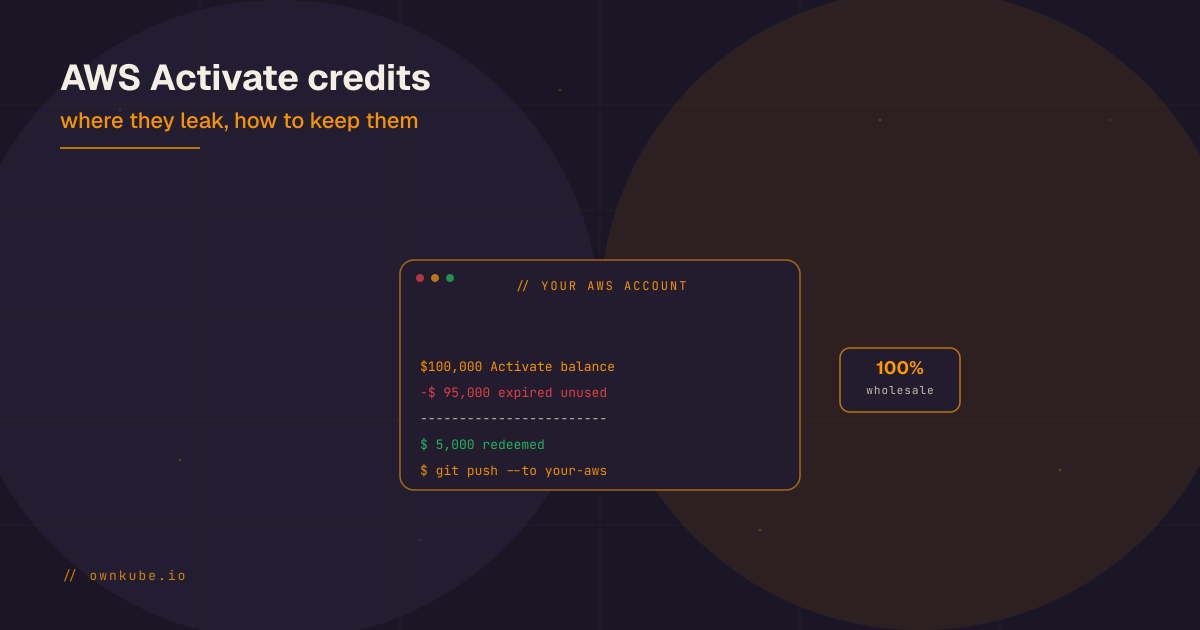
| AWS Activate credits redeemed (no AWS workloads) | ~$0 to $5,000 |
| AWS Activate credits expired unused | $95,000+ |
The credits were free dollars from your investor’s relationship with AWS, earmarked for you, and they expired into the void.
The framing we use at Ownkube is straightforward: your AWS Activate credits were meant for AWS, not your PaaS vendor’s margin. The only way to actually capture them is to run your compute, databases, and storage inside an AWS account you control, at wholesale rates.
This isn’t an argument against managed PaaS in principle. It’s an argument against unwittingly paying twice: once to AWS for credits you don’t use, once to the PaaS for compute that should have been on AWS.
A worked example: capturing the credits without the ops burden
Take a hypothetical seed-stage SaaS with one web service, two background workers, a 50GB Postgres, and rotating PR preview environments. Roughly 8 vCPU and 16 GB of production pods plus 4 vCPU and 8 GB for previews.
Option A: Heroku.
- Heroku Performance dynos, Postgres Standard-2, Redis Premium-1, preview apps.
- Approximate monthly bill: $2,400 to $3,200.
- Activate credits redeemed: $0.
- Year-1 cash out the door: ~$30,000 to $38,000.
- Activate credits left expiring: ~$70,000+.
Option B: managed Kubernetes (EKS) in your own AWS account.
- EKS control plane + 2 multi-AZ node groups + RDS Postgres Multi-AZ + ElastiCache + ALB.
- Approximate monthly AWS bill at wholesale: $1,100 to $1,600.
- Activate credits redeemed: 100% of the bill until credits run out.
- Year-1 cash out the door: $0 until credits exhaust (typically month 8 to 14 at this scale).
- DevOps overhead: significant unless abstracted (you’d typically need a DevOps engineer or equivalent).
Option C: platform layer in your own AWS account.
- Ownkube BYOC: Starter (free forever, one instance) for early development, Production ($5 per vCPU + $1 per GiB RAM) once you scale to multiple nodes.
- Same wholesale AWS bill as Option B.
- Activate credits redeemed: 100% until exhausted.
- DevOps overhead: builds, deploys, TLS, a Cloudflare-backed domain, managed Postgres, logs, metrics, and rollbacks come with the platform instead of being separate projects.
- Year-1 cash out the door: small platform fee (free on Starter, $5 per vCPU + $1 per GiB RAM on Production).
Option C captures the credits and skips the DevOps hire. That’s the combo most seed and Series A founders we talk to are optimizing for.
When credits aren’t the right reason to choose AWS
Be honest with yourself: if your team doesn’t need AWS-specific capabilities, don’t pick AWS just for the credits. The credits expire. The architecture decision doesn’t.
Cases where AWS is a fine technical fit regardless of credits:
- You need compliance certifications (SOC 2, HIPAA, FedRAMP) and AWS’s evidence story is shortest.
- You need specific AWS services (S3, DynamoDB, Bedrock, SageMaker) that your application directly depends on.
- Your enterprise customers contractually require their data to be in AWS, in their region, under their KMS keys.
- You expect to scale into spot instances, multi-AZ, multi-region, or private VPC peering with vendors.
Cases where AWS plus Activate is the wrong reason:
- “We just want the credits.” If you’re going to run on a different cloud anyway, the credits won’t save you.
- “We’ll migrate later.” Migration is expensive. The bill you avoid by not migrating is usually larger than the credits you’d have captured.
Decision checklist
Before you apply, confirm:
- You have a partner referral that unlocks the highest tier you’re eligible for.
- Your AWS account is set up under Organizations (or you’re fine starting in a single account and migrating later).
- You have a realistic plan to spend the credits inside the validity window.
- Your application workloads are or will be hosted in AWS, not on a marked-up PaaS that doesn’t accept Activate credits.
- You have a strategy for handling the recurring DevOps work (hire, software, or shared with backend team).
If you can’t tick the last two, you’ll watch most of the credits expire unused.
Closing
AWS Activate credits are one of the strongest economic levers a funded startup has in 2026. Up to $100,000 of free AWS spend, applied to compute, databases, storage, and edge, runs production for most seed-stage SaaS for a full year. The catch is that the credits only land if your stack actually runs in your AWS account, at wholesale rates, and not behind a platform markup.
If you want to capture every credit dollar at wholesale and skip the DevOps hire, Ownkube runs in your own AWS account with builds, deploys, TLS, managed Postgres, and autoscaling built in, and never marks up your compute. Starter is free forever on one instance; Production is $5 per vCPU plus $1 per GiB RAM per month once you scale. See Ownkube pricing for the per-minute wallet model, from $5 a month. Deploy your first app.

// written by
Abhishek Jaiswal · Founder and EngineerAbhishek Jaiswal is the founder and engineer behind Ownkube, a cloud for personal software. He builds the platform and writes here about cloud cost, migrations, and running production infrastructure in your own AWS account without a DevOps team.