“Internal developer platform” (IDP) is the most overloaded term in the 2026 infrastructure conversation. Some people mean a Backstage portal. Some mean a Kubernetes setup with golden paths. Some mean a custom-built layer on top of AWS that abstracts away the rough edges. All of those are correct. None of them are useful when you’re a 10-person team trying to decide what to actually do.
This post is the operator-level definition. We’ll cover what an IDP is in plain English, the four signals that say your team has crossed the line where one would help, the three common shapes IDPs take in the wild, and a build-vs-buy framework that most growing startups settle into.
Skim answer:
- What it is: software that gives engineers a self-serve way to deploy applications, run services, and access infrastructure without filing tickets or memorizing cloud-vendor consoles.
- Who doesn’t need one: a 5-engineer team.
- Who almost always does: a 25-engineer team.
- The crossover: around 10 to 15 engineers, when ad-hoc DevOps starts taxing senior engineers’ weeks.
What an IDP actually is
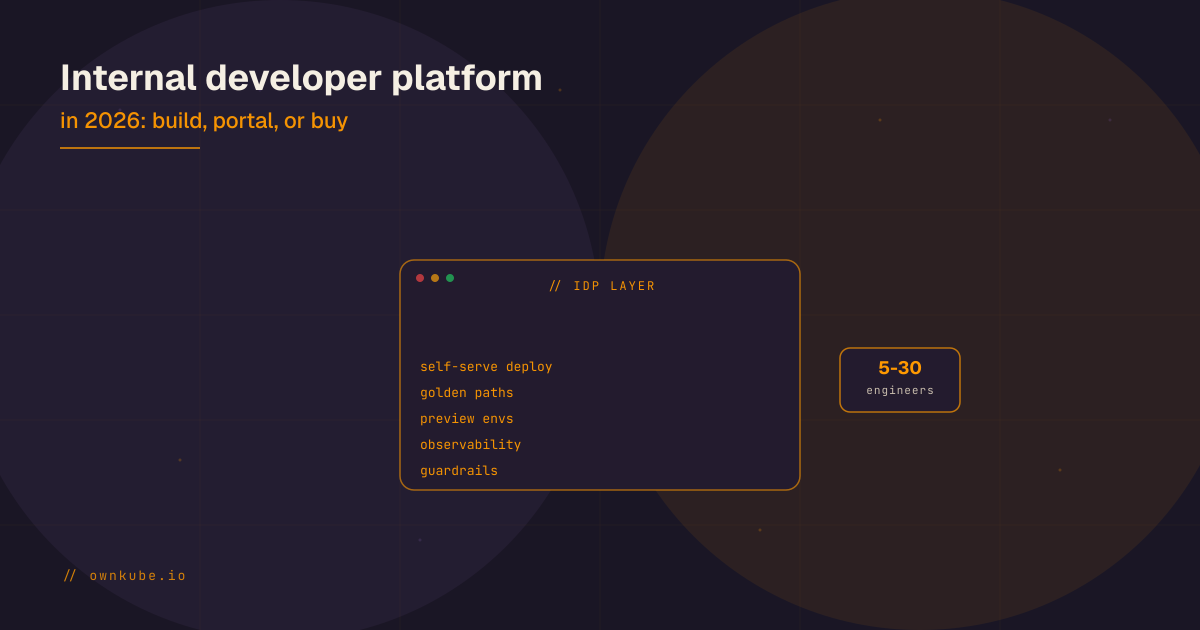
Strip away the conference-talk language and an IDP is a layer with five jobs:
- A self-serve deploy path. An engineer pushes code, the platform builds and deploys it. No tickets, no Slack DMs to the one person who knows how the cluster works.
- Golden paths. Opinionated templates for common patterns: a web service, a worker, a cron, a database, a queue. New services start from the template, not from a blank YAML file.
- Environment management. Production, staging, and preview environments per pull request, on demand.
- Observability and access. Logs, metrics, and SSO into running containers, available to the engineer who owns the service, not gatekept by a platform team.
- Guardrails. Policies that prevent obvious mistakes (a workload without resource limits, a public S3 bucket, a secret in plain text) without blocking velocity.
Notice what’s not on the list. An IDP is not a Kubernetes cluster. Kubernetes is one possible substrate. An IDP is not Backstage. Backstage is one possible portal. An IDP is not a custom Terraform monorepo. That’s one possible implementation. The IDP is the experience the engineer has, regardless of what’s underneath.
The four signals that say you need one
We see startups try to spec out an IDP project for two reasons: a real signal that the current ad-hoc setup is breaking, or a vanity project (“Stripe has Backstage so we should have Backstage”). The second is expensive. Watch for the first.
Signal 1: Senior engineers are spending more than a day a week on deploys, alerts, and infra tickets. This is the canonical break-even moment. The cost of building or buying a platform is justified when you have measurable engineering time being burned on recurring ops.
Signal 2: New hires take more than a week to ship their first production change. If the answer to “how do I deploy this?” requires a half-day onboarding session, the platform is the bottleneck. A good IDP makes this a 30-minute walkthrough.
Signal 3: You have more than two flavors of “how to deploy a service” in production. Some services use one set of scripts, some another, some are deployed by hand. This is a leading indicator of a real incident waiting to happen.
Signal 4: Compliance is asking who can access what, and you can’t answer in less than an hour. SOC 2, HIPAA, and enterprise procurement all want auditable, policy-enforced access. An IDP centralizes the answer.
If two or more apply, you’re past the line. If only one, you can probably hold off another quarter and revisit.
The three shapes IDPs take in 2026
In the wild, IDPs land in one of three patterns. None of them is wrong; they’re each right for a different team size and stage.
Shape 1: The custom-built monorepo
A platform team builds and operates the IDP in-house. Usually on top of Kubernetes (EKS for AWS shops), with Terraform or Pulumi for cloud resources, ArgoCD or Flux for GitOps, Backstage or a custom portal for developer self-serve, OPA or Kyverno for policy.
Best for: large engineering organizations (100+ engineers) where the platform team can be 5+ people, and where the business value of a perfectly bespoke developer experience justifies the multi-year roadmap.
The honest cost: a dedicated platform team of 4 to 8, plus tooling licenses, plus the ongoing maintenance burden as Kubernetes versions, AWS services, and security policies evolve.
Shape 2: The Backstage-style portal on existing infrastructure
A smaller team adopts Backstage (or similar) as a service catalog and developer portal, on top of whatever cloud infrastructure they already run.
Best for: mid-size organizations (30 to 100 engineers) that already have a platform engineering function and want a unified front-end across heterogeneous backends.
Where it stops fitting: Backstage is a portal, not a platform. It doesn’t deploy your services for you. Underneath, you still need the platform substrate. For most startups, the cost of building the substrate is the actual work.
Shape 3: A platform layer that already exists, on your cloud account
A managed product that runs in your own AWS, GCP, or Azure account and gives you the self-serve deploy, golden paths, environment management, observability, and guardrails out of the box. You don’t operate the platform; you use it.
Best for: 5- to 50-engineer startups that want IDP-level developer experience without standing up a platform team to build it.
Where it stops fitting: if you have genuinely bespoke infrastructure that no managed product abstracts (real-time streaming on custom hardware, regulated workloads with unusual constraints), you’ll end up customizing the platform layer or running parallel custom infrastructure.
The build vs buy framework
When teams ask us “should we build or buy”, the framework we use:
| Question | Build | Buy |
|---|---|---|
| Team size | 30+ engineers | 5 to 30 engineers |
| Dedicated platform owners | 3+ committed for 18+ months | Fewer than 3, or part-time |
| Cloud surface | Multi-cloud, heterogeneous | Single cloud (AWS, GCP, or Azure) |
| Workload uniformity | Highly diverse (real-time, ML, batch, web) | Standard web, workers, cron, DB |
| Compliance pressure | Hard requirements (FedRAMP, regulated industries) | Standard (SOC 2, HIPAA) |
| Time to value | Can afford 12 to 18 months | Need IDP-level DX inside one quarter |
| Strategic differentiation | DX is a competitive advantage | DX is necessary, not differentiating |
Most 2026 startups land firmly on the “buy” side of every row. The honest reason most “build” projects start is that one senior engineer wants to design a platform. That’s a fine motivation if you have the size and runway. If you don’t, it ends with a half-finished platform and a smaller team.
What the automated version looks like
A point that’s specific to 2026: the build-vs-buy question now has a third option that didn’t exist three years ago.
You can buy a platform layer that already handles the recurring operational work the platform produces. At Ownkube that covers:
- Self-serve deploys. Push a repo or a container, get a build pipeline, a zero-downtime rollout, and a one-command rollback, on hosted infrastructure or inside your own AWS account.
- A ready-to-share domain and TLS. A Cloudflare-backed domain with DDoS, bot, and scrape protection on day one, or CNAME your own.
- Managed Postgres and Valkey cache. Operated for you, the same on Ownkube Compute and in your own cloud.
- Logs, metrics, and horizontal autoscaling. One place to see what’s running, with replica counts that adjust to traffic automatically.
This doesn’t replace strategic platform decisions. It covers the recurring checklist that would otherwise either fall on a senior engineer or push you to hire a DevOps engineer at ~$200K loaded. For a 5- to 30-engineer team, that’s the gap that makes the platform layer credible as a substitute for hiring a platform team.
When you genuinely don’t need an IDP
Be honest with yourself. If you’re 5 engineers, you ship a couple of services, your AWS bill is under $1,000 a month, and nothing in the four signals applies to you, you don’t need a platform. You need a deploy script and an alerting integration. The temptation to over-engineer at small team size is real and expensive.
Revisit the question every quarter. The signals usually trip before you expect them to.
Decision checklist
- Are senior engineers spending more than a day a week on deploys and infra tickets?
- Is onboarding a new hire to production taking more than a week?
- Are there more than two ways to deploy a service in production today?
- Is compliance pressing on access control and audit trails?
- Are you on AWS specifically (because of credits, compliance, or customer requirements)?
- Is your team between 5 and 30 engineers without a dedicated platform owner?
Two or more on the first four: you need an IDP. Yes on the last two: you almost certainly want to buy, not build.
Closing
The IDP conversation in 2026 is no longer about whether your team needs one. For most growing startups, the moment is going to arrive between engineers 10 and 25. The conversation is about whether you’ll build it, portal-stack it, or buy a managed layer that already exists.
If you want a managed IDP that runs in your own AWS account, handles the recurring ops, and starts free on a Starter instance, Ownkube is built for that. Or skip the cloud account entirely and ship on Ownkube Compute. See Ownkube pricing for the per-minute wallet model, from $5 a month. Deploy your first app.

// written by
Abhishek Jaiswal · Founder and EngineerAbhishek Jaiswal is the founder and engineer behind Ownkube, a cloud for personal software. He builds the platform and writes here about cloud cost, migrations, and running production infrastructure in your own AWS account without a DevOps team.