If you’ve been on Heroku since the Salesforce era and haven’t reviewed the bill in a year, this is the post for you. The 2026 pricing surface is meaningfully different from 2023. The free Eco dyno is gone. Performance dyno minimums have crept up. The “essential” Postgres tiers got a polish but not a discount. For a small team paying the bill out of runway, the line items add up faster than they used to.
Short answer for skim readers: a typical 5-person Heroku stack (1 Performance-M web dyno, 2 Performance-S workers, Postgres Standard-2, Redis Premium-1, review apps) runs around $1,400 to $2,200 a month in 2026. The same workload on your own AWS account at wholesale runs around $400 to $550. The gap is not Heroku doing something wrong; it’s the cost of running on someone else’s infrastructure at someone else’s margin.
The honest question isn’t “is Heroku too expensive”. It’s “is the developer experience still worth the difference, given what the alternatives have become”. Let’s walk through that.
The 2026 Heroku price surface
Approximate published rates as of April 2026 (your numbers vary with region, traffic, and any negotiated enterprise terms):
Dynos
| Tier | RAM | Approx. monthly |
|---|---|---|
| Basic | 512 MB | $7 |
| Standard-1X | 512 MB | $25 |
| Standard-2X | 1 GB | $50 |
| Performance-M | 2.5 GB | $250 |
| Performance-L | 14 GB | $500 |
| Performance-L-RAM | 30 GB | $750 |
Heroku Postgres
| Tier | RAM | Storage | Approx. monthly |
|---|---|---|---|
| Essential-0 | shared | 1 GB | $5 |
| Essential-2 | shared | 10 GB | $25 |
| Standard-0 | 4 GB | 64 GB | $50 |
| Standard-2 | 8 GB | 256 GB | $200 |
| Standard-4 | 16 GB | 512 GB | $400 |
| Private-2 | 8 GB, dedicated VPC | 256 GB | $1,500+ |
Heroku Redis (Key-Value Store)
| Tier | Memory | Approx. monthly |
|---|---|---|
| Mini | 25 MB | $3 |
| Premium-0 | 50 MB | $15 |
| Premium-1 | 100 MB | $30 |
| Premium-2 | 250 MB | $60 |
| Premium-5 | 1 GB | $300 |
These prices have not moved dramatically since 2024, but the floor has. The old “$0 hobby dyno + $9 hobby Postgres” starter stack doesn’t exist anymore. The minimum credible production stack starts in the high three figures.
A worked example: small SaaS in 2026
Take a 5-engineer SaaS in its first year of production. The workload:
- 1 web service, moderate traffic
- 2 background workers (queue consumers)
- Postgres holding ~30 GB of customer data
- Redis for session and rate-limiting
- Review apps on every pull request
On Heroku
| Component | Tier | Approx. monthly |
|---|---|---|
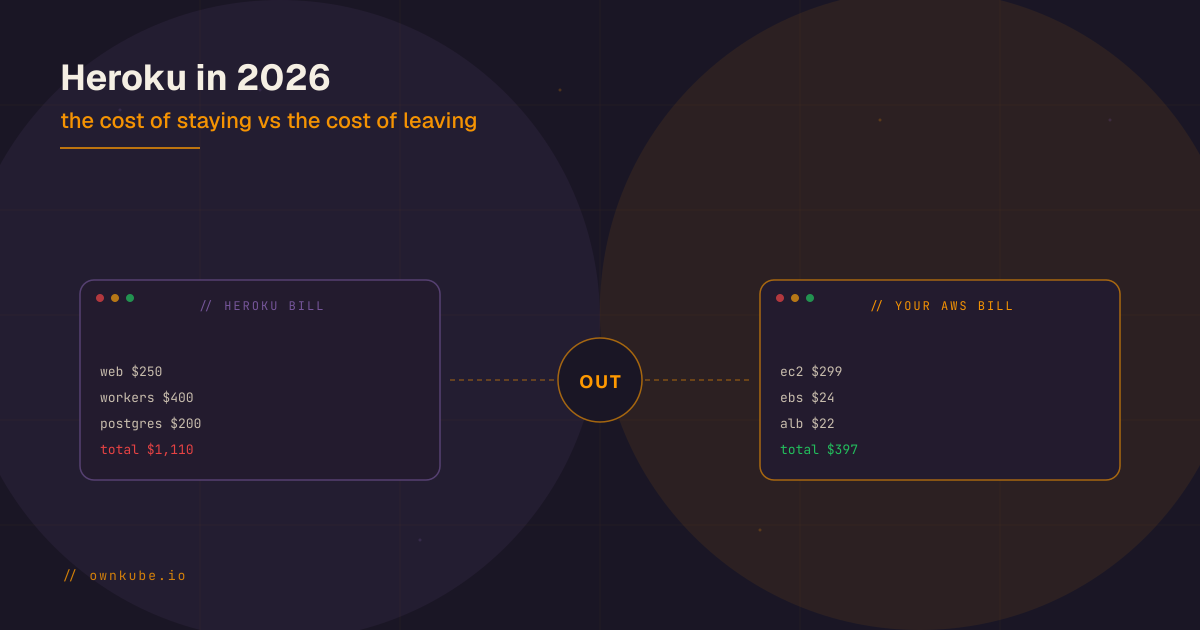
| Web | Performance-M | $250 |
| Workers (2 ×) | Performance-S | $400 |
| Postgres | Standard-2 | $200 |
| Redis | Premium-1 | $30 |
| Review apps (5 active) | mixed | $150 |
| Add-ons (Papertrail, Bonsai, etc.) | various | $80 |
| Total | ~$1,110 |
That’s a clean small case. With more workers, higher Postgres tier, or Private Space for compliance, the same workload runs $2,500 to $4,000.
On your own AWS account at wholesale
Same workload, running on EC2 with mixed on-demand and autoscaled capacity:
| Component | Spec | Approx. monthly |
|---|---|---|
| 3 × t3.xlarge (mixed on-demand + autoscaled) | 12 vCPU / 48 GB | $299 |
| 300 GB EBS gp3 | $24 | |
| Postgres (operated by platform layer on EC2) | 30 GB | included in EC2 |
| Valkey cache (operated by platform layer on EC2) | small | included in EC2 |
| ALB | $22 | |
| NAT (1-AZ, small) | $32 | |
| Data transfer (moderate) | $20 | |
| Wholesale AWS total | ~$397 |
Plus a platform fee. On Ownkube’s BYOC Starter tier, free forever on one instance, a single-node version of this workload costs $0 in platform fees. On Production, metered at $5 per vCPU plus $1 per GiB RAM for real multi-node redundancy: about $108 for the same 12 vCPU / 48 GB footprint.
The delta is roughly $700 a month at the small case and $2,000+ a month as you grow. Over 18 months that’s $12,000 to $36,000.
What Heroku is genuinely still good at
Before getting talked into a migration, be fair to the incumbent. Heroku in 2026 is still:
- The easiest “git push, get a URL” experience on the market. New engineers are productive in an afternoon.
- The most mature add-on ecosystem. If you need a niche service (a specific search engine, a specific scheduler, a specific log shipper), there’s a one-click add-on.
- A genuinely good Postgres operator. Backups, PITR, follower databases, fork-and-restore. The DBA-grade features come free with the tier.
- Predictable on day one. No NAT gateway surprises, no IAM permission dance, no Kubernetes upgrade calendar to track.
If your bill is small, your traffic is small, and your team is small, Heroku is fine. Move on with your life.
Why teams eventually leave
The triggers in our network in 2026 are consistent:
- The bill stops making sense. Specifically: when the Heroku bill is bigger than the equivalent AWS bill by a factor of two or more, founders start asking questions. That ratio is usually crossed somewhere between $1,500 and $3,000 a month.
- The compliance conversation gets harder. Customer security reviews want to know where data is processed. “Salesforce-owned shared infrastructure” is a slower answer than “our VPC in us-east-1”. SOC 2, HIPAA, and most enterprise procurement forms strongly prefer the second.
- The AWS credits are stranded. Funded startups carry up to $100,000 in AWS Activate credits. Heroku bills don’t redeem against them. So a startup running entirely on Heroku watches six figures of credits expire unused.
- Architectural ceilings. Private networking, GPU workloads, VPC peering with a vendor, batch jobs that need spot capacity. These are either painful or impossible on shared PaaS.
The decision usually isn’t “Heroku is bad”. It’s “the math has flipped and we’d rather spend the gap on engineering”.
What’s actually different in 2026
The reason the math has flipped: the alternatives are better than they used to be.
- Self-hosted PaaS options matured. Coolify, Dokku, and CapRover all shipped major releases in the last two years. We compared them in self-hosted PaaS in 2026.
- Managed Kubernetes is closer to “boring”. The ecosystem has settled: EKS and k3s both run most workloads without bespoke tuning, and a platform layer like Ownkube hides the operational edges either way, so you get the stability without touching the control plane.
- Platform layers do more out of the box. Cost optimization, incident triage, IAM drift detection, and scaling decisions used to require a senior DevOps engineer’s daily attention. In 2026 a platform layer can cover the recurring checklist directly, without a dedicated hire.
This last shift is what makes the “leave Heroku, keep the developer experience” pitch credible at small team size. You don’t need a $200K DevOps hire to operate the alternative; you need a platform layer that’s already operated.
A side-by-side decision frame
When teams ask us “should we leave Heroku”, the answer hinges on these five questions:
- Is your Heroku bill over $1,500/month and growing more than 30% year-over-year?
- Are you on a compliance path that wants data sovereignty (SOC 2, HIPAA, enterprise procurement)?
- Are you funded and carrying AWS Activate credits you’re not redeeming?
- Do you have specific architectural needs (GPU, private VPC, spot capacity) that Heroku doesn’t serve well?
- Are you under 20 engineers, with no dedicated platform owner, and want to keep the git-push experience?
Three or more yeses, and the move is usually worth the migration cost. The honest version of the migration is one to three weeks of focused work for a typical small-team stack, depending on how much you rely on Heroku-specific add-ons. We covered the workflow translation in detail in Heroku alternative in your own AWS account.
When to stay on Heroku
There are honest cases. Stay if:
- Your team is 1 to 3 engineers and the Heroku bill is under $500/month.
- Your application’s value is not in unit economics. (e.g. internal tools, low-revenue side projects.)
- You’re 90 days from a launch and a migration would push the launch date.
Don’t move for ideology. Move when the math justifies it.
Reference: For the side-by-side breakdown, see Ownkube vs Heroku in the docs.
Closing
The 2026 reality is that Heroku is still good at what it does, but the cost of staying has grown faster than the cost of leaving has dropped. For a 5- to 20-person team on a real growth curve, the move to your own AWS account with a platform layer on top is the move that captures credits, lowers the bill, and keeps the workflow.
If you want that workflow without operating it yourself, Ownkube is built for the migration. Free on a Starter instance in your own AWS account, $5 per vCPU + $1 per GiB RAM on Production when you need multi-node, or skip the AWS account entirely and ship on Ownkube Compute from $5 a month. Deploy your first app.

// written by
Abhishek Jaiswal · Founder and EngineerAbhishek Jaiswal is the founder and engineer behind Ownkube, a cloud for personal software. He builds the platform and writes here about cloud cost, migrations, and running production infrastructure in your own AWS account without a DevOps team.